Teaching for Wonder
What is school for, anyway?

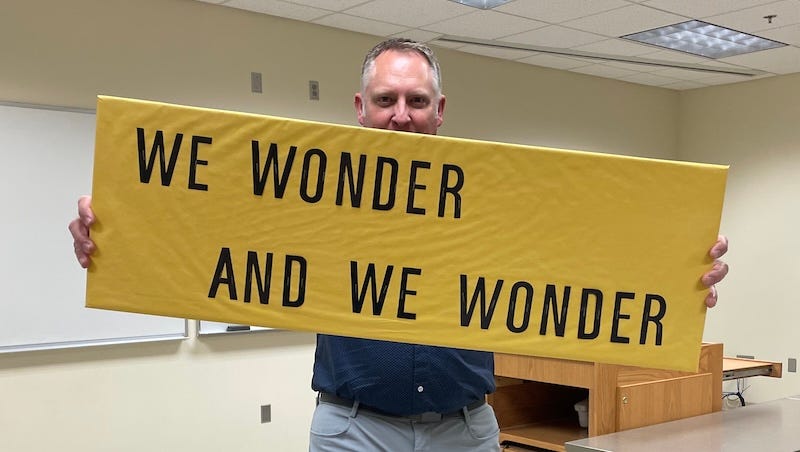
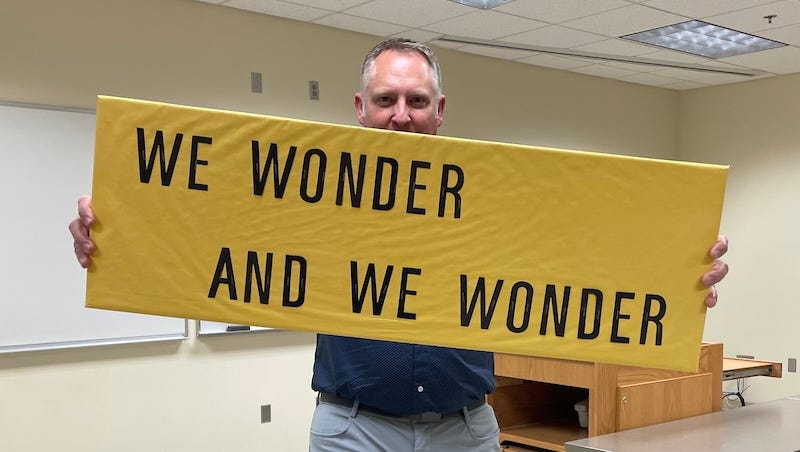
The storyline I use when I teach Methods of Teaching Science is “We WONDER and we WONDER.” I like the fact that the word “wonder” has multiple meanings. We can use “wonder” to describe the curiosity and inquisitivity. We can also use “wonder” to describe a sense of awe and amazement.
Maybe this is peculiar to science education, that “wonder” might apply equally in both of these sense of the word? That my students wonder about the world…and then they stand in wonder at the things they discover? I suspect this is not limited to science class though; I think students can wonder and wonder in many different subject areas. And, truly, I think they should!
I sometimes think we’ve lost the plot in education by reducing it to mere information transfer. When we focus only on the facts…do students really learn? Or do they just get really good at trivia games?
Please don’t misunderstand me. Students definitely should learn facts. (And I actually love trivia games!) But if those facts are not fit into a broader context of meaning, and are not encountered in a way that sparks joyful engagement, and are not part of a broader sense that education is doing something to the learner…well, maybe it’s no wonder so many students report that they don’t like school very much.
I think we’ve lost something in the age of high accountability, overstuffed curriculum, and standardized testing. We’ve forgotten our capacity to wonder.
And I’m talking here about educators as well as students.
I’m working on a new book, a book that will be a sort of nuts-and-bolts “field guide” to teaching Christianly. My hope it that it will give some really practical strategies for living out Christian faith in the small-scale decisions we make in the classroom. But those small-scale decisions need to happen within some kind of framework.
I’d like to share the framework I’m developing here, and I’d love to hear your thoughts about this, friends.
There are many different teaching methods we might choose among, after all. I think they fall along a continuum, which perhaps looks like this:

On the “delivery” side of the continuum would be strongly teacher-directed approaches. Lecture, obviously. But also thinks like reading a textbook, watching a YouTube video, and other forms of direct instruction would most likely be considered content delivery.
On the “discovery” side of the continuum would be more student-directed approaches. Strategies like inquiry-based science investigations, self-directed research projects, and many problem-based learning experiences would be considered discovery-oriented learning.
And certainly there are combination approaches that would be somewhere in the middle of this continuum, depending on the level of teacher-direction. This continuum from delivery to discovery might also be considered “prescription” vs. “participation.” What is the students’ involvement in their own learning?
At the same time, there is another factor we might consider, one that gets at the approach toward the content of the curriculum. I think the curriculum approaches might be arranged on a continuum like this:

On the “information” side, we might see more didactic, “just the facts” approaches toward the curriculum. The emphasis here might be on content-heavy resources that all students get to engage.
On the “imagination” side, we might see more collaborative, curious, questioning approaches to the curriculum. It’s not that facts aren’t important, but by reducing the sheer amount of content, we might find more opportunities for students to engage in exploratory approaches, where different students might use different resources.
And, again, there are probably curriculum approaches that fit somewhere in between these poles, where the teacher guides students with some shared resources and experiences, and the students also bring their interests and experiences to bear. This continuum from information to imagination might also be considered “mechanism” vs. “meaning,” or perhaps “what is” vs. “what if?”
Now, here’s where things get interesting for the framework I’m playing around with: what if we cross these two? We might wind up with a mental model that looks like this:
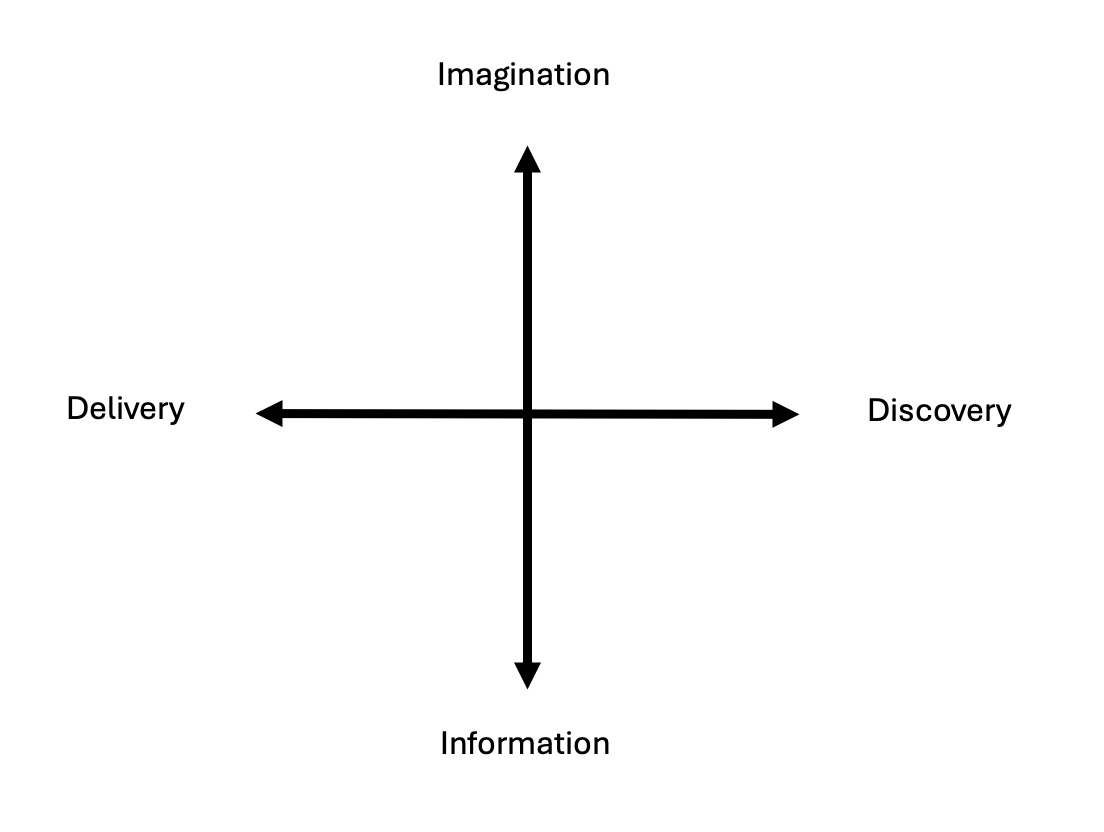
Now there is a grid we could use to imagine where different classroom practices might be located.
Where would we place a lecture? Probably in the lower-left quadrant, with emphasis on delivery of information.
How about the teacher telling a story to help illustrate a concept? That might push us up into the upper-left quadrant, with delivery as the mode, but sparking imagination as the goal.
Or consider a student research project with clear directives about the resulting report of their learning. Perhaps this would be located in the lower right quadrant, with an opportunity for first-hand discovery, and a strong focus on conveying the key information.
And finally, we might envision a classroom discussion of a real social issue, where groups of students prepared for the discussion by reading different things that illustrate different perspectives on the issue. I suspect we might find ourselves in the upper right quadrant now, with discovery of new ideas, and the development of imaginative responses as the result.
Please note here that I’m not suggesting that any of these learning opportunities are better (or worse) than the others. They are simply different approaches.
But I do wonder how much time students in school today spend in the lower left quadrant of this framework, with most of the work being strongly teacher-directed and information-heavy. I suspect it’s…a lot. And my hope in proposing this framework is that it opens up more possibilities for teachers and students alike.
Because here’s my point: moving “up” in the framework from focusing just on information to incorporating more imagination almost certainly will provide more opportunities to “wonder.” Likewise, moving “right” in the framework from focusing just on delivery to infuse more discovery will also provide more opportunities for “wonder.”
It’s not that it’s bad practice to focus on delivering information. But I think it might be a more promising practice to not just focus on delivering information.
What do you think? Is there something to this idea of teaching for wonder?
Things to Read
A few suggestions for you of things I’ve read and listened to lately that I think you might find interesting, informative, or provocative…
“Everyone Is Horrified by the Way Things Are Being Done” - from The Preamble, an incredible, must-read interview with longtime U.S. Ambassador A. Elizabeth Jones (the real-life inspiration for the heroine of the TV show, The Diplomat)
Moral and Spiritual Hunger in the Classroom - a thoughtful and thought-provoking post from my former colleague, Davey Henreckson
What Is the Point of Education Anyway? - a wonderful piece from my Aussie pal, Paul Matthews, who thinks and writes a lot about AI for Christian educators
“Save Time with AI”: How Software Disciples Us - A thoughtful piece by David Smith about the formative nature of reading—and the formative nature of using AI to summarize instead of reading

Dave’s Faves
Here are three things I’m absolutely loving right now that I hope you might love too…
Dave’s Fave #1: The Ten Minute Bible Hour
I have a morning routine that includes listening to two short podcasts while I’m getting ready for my day. The second one is a short news podcast, but the first? The Ten Minute Bible Hour. Matt Whitman hosts this podcast, which is a 10-ish minutes per day exploration of scripture, doing thoughtful exegesis, including the historical and cultural context. We go through a book at a time, taking as long as we need to explore the book. (We just wrapped up a series on the Book of Philemon, which is one of the shortest books in the Bible…but it took us 80 episodes to explore it completely. But it’s just 10 minutes a day…and Matt does a great job taking scripture seriously while not taking himself too seriously—right up my alley!)
TMBH began a new season on Monday on the Gospel of John, and I invite you to join in the fun and learning this season. If you need a quick-burst daily dose of Bible, I’m confident you’ll be encouraged by listening.

Dave’s Fave #2: A good coffee mug!
I love a good mug, and this one was a lovely gift from a school I worked with when I was in Indonesia last November. I use it every day!

Dave’s Fave #3: Resurrection Letters, Vol. 1
We had the pleasure of having Andrew Peterson on Dordt’s campus last week, where he had a concert and spoke in chapel. Peterson is a phenomenal singer-songwriter (and author, and creative, and faithful Jesus-follower.) His music hits me right in the soul, and I hope it will bless you as well. This week I’m recommending his 2018 album, Resurrection Letters, Vol. 1, which includes perhaps his most recognizable song, “Is He Worthy?” But don’t miss “His Heart Beats,” and “Remember and Proclaim,” and “All Things Together”—all phenomenal songs!
The Last Word!
I’m excited that I’ll be speaking at the Association for Christian Schools International’s Flourishing School’s Institute next week. The topic of my keynote address? “Awakening Curiosity & Engagement for Christ-Centered Education.” Can you tell I’ve been thinking a lot about “teaching for wonder” lately?
Friends, I hope you’ll take this week’s newsletter as an encouragement, and not a burden. I’m encouraging you to play around with a few of these ideas, okay? But I hope you’ll be inspired to take that playful approach into your teaching, leading, and serving this week—model curiosity, practice wonder, and seek to get the kids engaged in meaningful work. Remember, we GET to do this!